
Temp Service for Construction in Santa Monica, Culver City, and West Hollywood
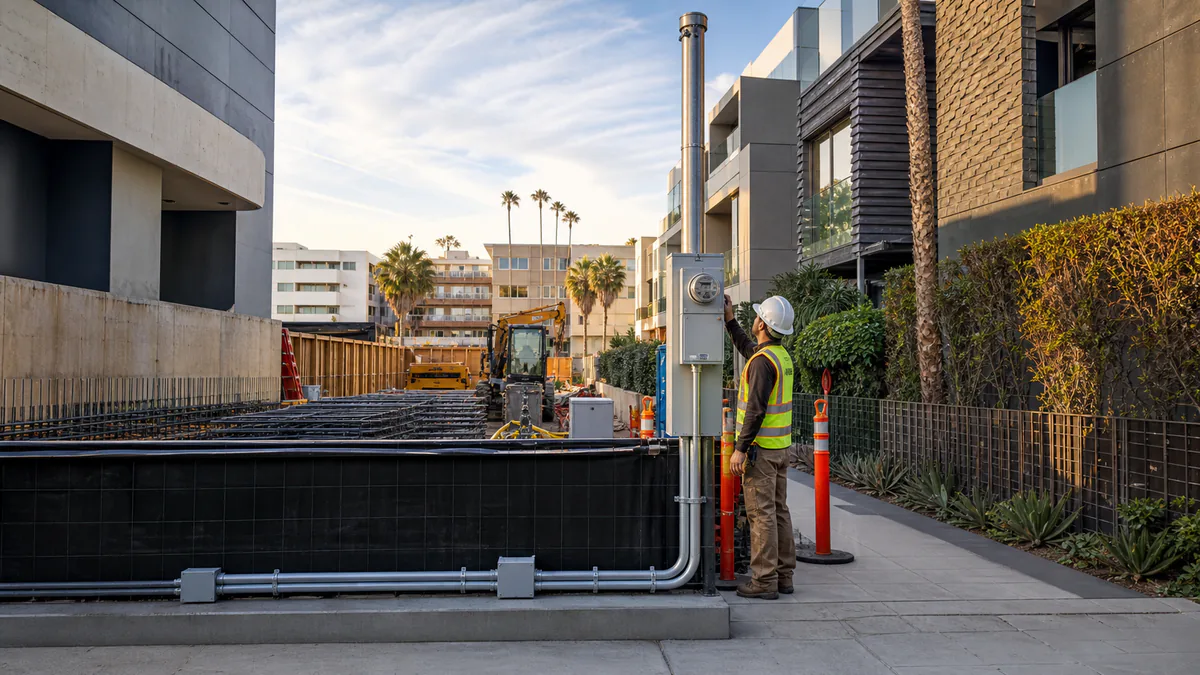
The Westside construction market in Los Angeles has its own set of conditions that contractors from other parts of SoCal run into fast. Property-line-to-property-line builds with no room for a standard pole. Underground utility infrastructure in newer commercial corridors. Tight urban lots where overhead wire runs are not practical. Three separate municipalities, each with its own Building and Safety department, sitting within a few miles of each other. Getting temporary power set up correctly on a Westside project requires knowing these conditions before the crew mobilizes.
Three Cities, Three Permit Processes
Santa Monica, Culver City, and West Hollywood are each independent municipalities with their own Building and Safety departments. They are not part of the City of Los Angeles, which means they have their own permit application processes, their own fee structures, and their own inspection requirements.
A contractor who regularly does work in the City of Los Angeles and assumes the LADBS process applies to a Santa Monica project will find the process runs differently. Each Westside city has specific submittal requirements that ACO’s permit expeditors know from direct experience.
Which Utility Serves Each Westside City?
Utility jurisdiction on the Westside is not uniform:
- Santa Monica: Southern California Edison. Despite being surrounded by LADWP territory, Santa Monica is fully SCE-served.
- Culver City: Southern California Edison.
- West Hollywood: West Hollywood is served by the Los Angeles Department of Water and Power.
The utility distinction matters because SCE and LADWP have different application requirements and different processes for the meter spot and energization. West Hollywood projects go through LADWP. Santa Monica and Culver City projects go through SCE’s service request and planner process. ACO confirms jurisdiction before any application is submitted. For a broader overview of how LADWP and SCE compare, see our Los Angeles Power Company overview.
Property Line to Property Line: A Common Westside Challenge
Dense urban development on the Westside means many construction sites have zero setback on one or more sides. There is no room for a standard 6x6x24-foot treated wood pole and an overhead wire run when the structure goes right to the property line.
ACO handles this with two approaches depending on site conditions. The first is a ground-run conduit installation: wire runs on the ground inside conduit rather than overhead, keeping the work area clear and eliminating the clearance problem. The second is a black diamond pole, which is a round pole 8 to 10 inches in diameter available in 25, 30, and 35-foot heights that provides more clearance than a standard pole when vertical height is the constraint. Both options are explained on ACO’s overhead and underground systems page, along with the cost difference compared to a standard overhead installation.
The step-by-step process for how these site-specific decisions get made is covered in our helpful temporary power pole information page, which includes photos of property-line-to-property-line conduit installations and multi-set configurations.
Underground Utility Infrastructure on the Westside
Commercial corridors on the Westside, particularly in Culver City and along Santa Monica’s newer development areas, frequently have underground utility infrastructure. For these sites, the temporary power connection requires conduit buried in a trench running from the utility source to the meter pole rather than a standard overhead span.
Underground installations cost more than overhead and take longer to complete. For sites in new developments where SCE has not yet set the transformer, the connection cannot be completed until SCE’s equipment is in place. This is the same sequencing issue covered in our posts on the Inland Empire and Ventura County markets. The fix is the same: confirm the transformer is set before scheduling ACO for installation.
Commercial Construction in Culver City and Santa Monica
Culver City has seen significant commercial and mixed-use construction growth, particularly around the Expo Line corridor and in the tech and media office market. Santa Monica’s commercial construction is active along Wilshire, Olympic, and the Third Street Promenade area. Both cities have a high concentration of shell-to-finish commercial buildouts where permanent utility service is not yet connected when construction begins.
For shell commercial buildouts on the Westside, a temporary power pole provides consistent utility-fed power from the start of construction through final inspection, without the daily fuel cost and maintenance overhead of a generator. Our comparison of temporary power poles vs. generators covers the cost and operational differences in detail. For projects where a generator is the right call for a short phase of work, ACO also offers generator rentals across the Westside.
Residential Construction in West Hollywood and Santa Monica
Residential construction in West Hollywood and Santa Monica includes teardown and rebuild projects on narrow lots, multi-unit residential buildouts, and ADU additions. For projects in these cities, the same ADU and residential considerations that apply across LA County apply here, including the building permit sequencing requirement and the utility-specific application process. The full walkthrough of what that process looks like is in our guide on what to expect when you rent a temporary power pole in Los Angeles.
Site Lighting and Trailer Connections on Westside Projects
Westside construction sites in dense urban areas benefit from automatic overnight site lighting connected to the temporary power pole. Sites in West Hollywood and Santa Monica are often adjacent to occupied residences and active commercial properties, making a secured and lit site important throughout the project. For projects running a job site office trailer, ACO’s trailer connection service connects directly from the pole to the trailer panel.
Start the Permit Process Early on Westside Projects
Westside cities can have longer plan check and permit timelines than some other parts of LA County, particularly for commercial projects in Santa Monica. Starting the temporary power application as soon as the building permit is approved, rather than waiting until construction begins, is the approach that keeps projects on schedule. ACO’s permit pulling service manages the full process across Santa Monica, Culver City, and West Hollywood, including follow-up with the utility through energization.
For a step-by-step overview of what the full process looks like, see our guide to temporary construction site power.
Call ACO at (818) 255-3560 or request a free estimate online to discuss your Westside project.

