Temporary Power Pole vs. Generator: Which Is Right for Your Construction Site?
Most contractors have used both at some point. A generator gets the lights on fast. A temporary power pole keeps a 6-month build running without the daily headache. The problem is that too many project managers default to one option without thinking through the actual job requirements, and that decision ends up costing them more time or money down the line.
This is a straightforward breakdown of how both options work, where each one makes sense, and what to consider before you commit.
What Is a Temporary Power Pole?
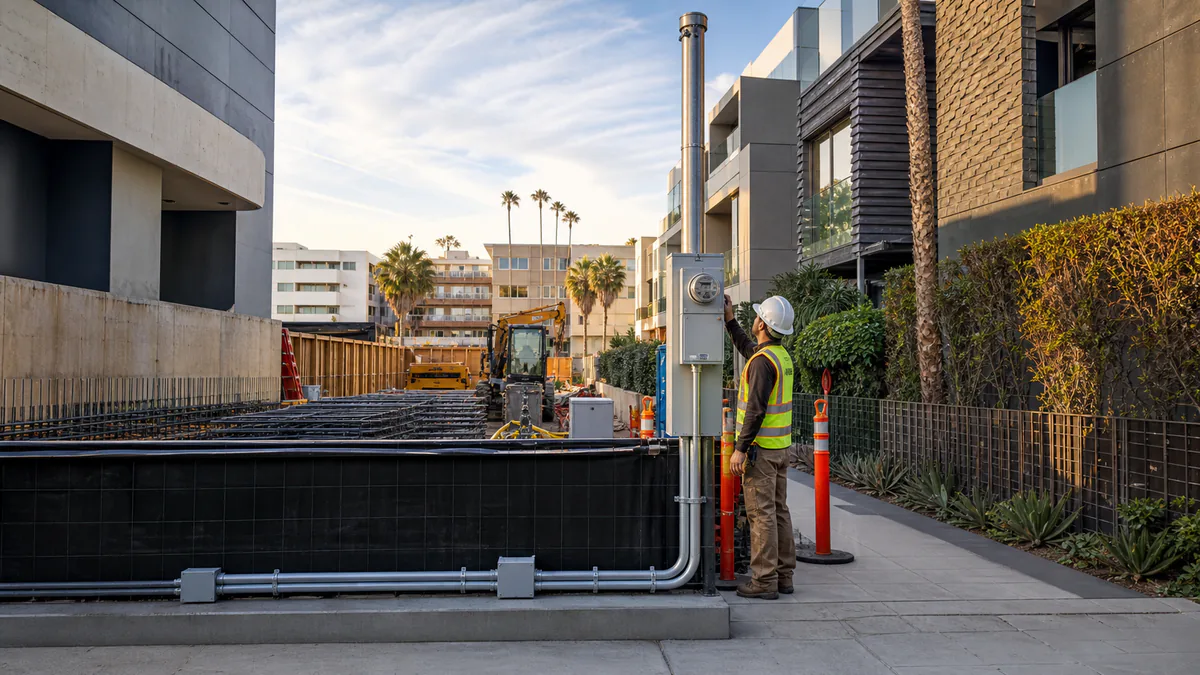
A temporary power pole is a metered electrical service installed directly on your job site. It connects to the utility grid through Southern California Edison or the LA Department of Water and Power, depending on your area. Once it is energized, it functions like permanent utility power. Your crew plugs into it, your trailer connects to it, your lighting system runs off it.
The installation process involves permits, a utility application, a site inspection, and coordination with the utility provider. That process is handled by your temporary power company. At A-CO, we manage the full permit workflow, including City Building and Safety permits and the SCE or LADWP application requirements, so contractors are not chasing paperwork while their project sits idle.
A-CO also handles overhead and underground system options, depending on the site layout and utility access. Underground is cleaner on congested sites. Overhead installations work well when utility lines are accessible and a trench is not practical.
What Is a Generator?
A generator produces its own electricity by burning diesel or gas. There is no utility connection and no permit required to start using one. You bring it to site, fuel it, and it runs.
That simplicity is the main reason contractors reach for a generator. For short jobs, remote sites with no nearby utility infrastructure, or situations where temporary power would take too long to install, a generator solves the immediate problem.
The tradeoff is ongoing cost and management. Fuel has to be ordered and tracked. Equipment needs regular maintenance. The generator runs only when it is running, and if it goes down mid-project, so does everything else.
Where Each Option Actually Makes Sense
When a temporary power pole is the right call:
- Projects longer than 4 to 6 weeks. The cost-per-day on utility power consistently beats generator fuel and maintenance on extended jobs.
- Sites with utility infrastructure nearby. If SCE or LADWP service is accessible, there is rarely a reason to bring in a generator for a full build.
- Jobs that require consistent load capacity. Power tools, lighting systems, trailer connections, and equipment charging running simultaneously require reliable amperage. A temporary power pole handles that without the output variability you sometimes see with generators under heavy load.
- Projects where noise and emissions matter. Generators are loud and produce exhaust. On residential sites, in densely populated neighborhoods, or near schools and hospitals, that becomes a real issue.
- ADU builds, residential demolition and reconstruction, commercial tenant improvements, and new construction where the job will run for months.
When a generator is the right call:
- Short demolition jobs or quick concrete pours where the work is done in days, not weeks.
- Remote locations with no utility access. If you are working in the hills, in a flood control basin, or anywhere utility lines do not reach, a generator may be your only option. That said, A-CO has installed temporary power in some genuinely remote areas across Southern California, so it is worth a call before you assume utility connection is not possible.
- Emergency situations where power is needed immediately and the permit timeline is not workable.
- Supplemental power alongside a temporary power pole when a specific piece of equipment has a load requirement that exceeds your installed service.
The Cost Question
Generator rental rates look affordable on day one. The number that catches contractors off guard is the cumulative fuel cost over a 90- or 120-day project. Diesel consumption adds up fast, especially when equipment is running full shifts.
Temporary power poles have a higher upfront cost that includes installation, permits, and utility fees. The monthly rental after that is fixed. On a job running three months or more, the math usually favors the power pole, often significantly.
The other cost that does not always get factored in is downtime. A generator that fails requires diagnosis, a repair call, or a replacement unit. That is lost hours on a project that has a schedule. Utility-fed temporary power does not have that variable.
Permit and Timeline Reality
One of the most common reasons contractors default to a generator is the assumption that temporary power takes too long to set up. That is sometimes true if you are managing the permit process yourself.
A-CO’s permit pulling service exists specifically to solve this problem. Our permit expeditors know the Building and Safety requirements for each city, the SCE and LADWP application processes, and what the inspection checklist looks like. We follow the job from permit application through energization, and we handle follow-up with the utility provider when there are delays.
The timeline varies by city and utility, but contractors who use A-CO are not managing that process themselves. You submit your project information, we handle the rest, and we keep you updated.
Site Lighting
One area where temporary power poles clearly win is site lighting. A-CO installs mercury vapor lighting systems that operate automatically from dusk to dawn. That keeps the site secure overnight without anyone managing it. Running that same lighting off a generator means fuel costs around the clock and someone responsible for making sure the unit is running.
Trailer Power
If your project has a job site office trailer, connecting it through your temporary power pole is the clean solution. A-CO’s trailer connection service runs directly from the pole to the trailer panel. That covers HVAC, lighting, computers, and anything else running inside the trailer without a separate power source.
The Honest Answer
For most construction projects in Southern California that run longer than a month, a temporary power pole from a reliable provider is going to be cheaper, more consistent, and less work to manage than a generator. The permit process is the one friction point, and that is exactly what A-CO handles.
For projects where the timeline is short, utility access is genuinely unavailable, or something is needed immediately, a generator is a practical tool. A-CO also offers generator rental services for situations where that is the right fit.
The decision should come down to the actual job requirements, not habit. If you are unsure which setup makes sense for your project, call A-CO at (818) 255-3560 and one of our estimators will walk through the specifics with you.