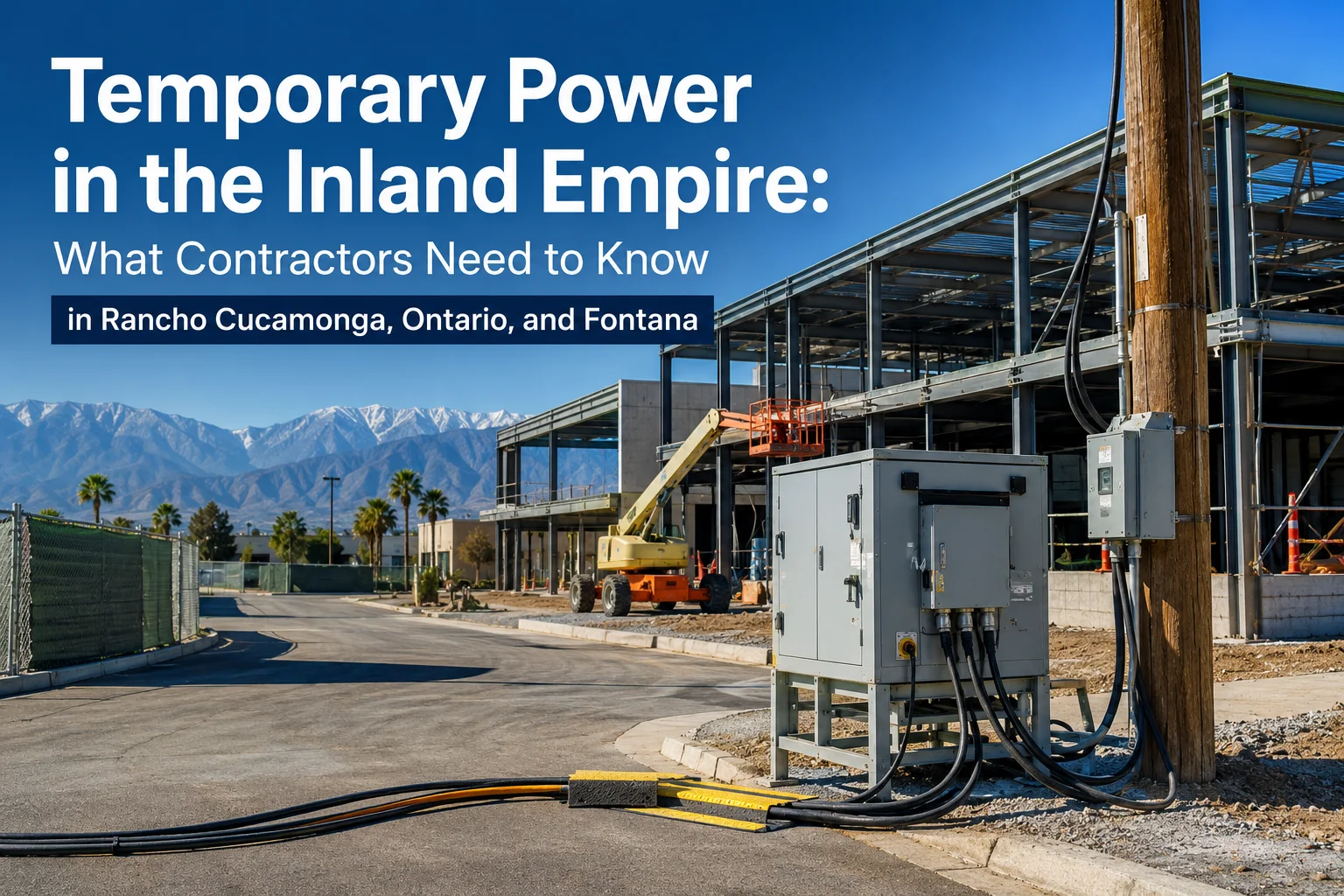
Temporary Power in the Inland Empire: What Contractors Need to Know in Rancho Cucamonga, Ontario, and Fontana
The Inland Empire has been one of the most active construction markets in Southern California for years. Warehouse and logistics development along the I-10 and I-15 corridors, residential tract builds in Rancho Cucamonga and Fontana, and commercial growth in Ontario have kept contractors busy across the region. All of it runs on SCE, which means the temporary power process follows a consistent framework across the IE, with city-specific permit variations that contractors need to account for before work starts.
The Inland Empire Is Entirely SCE Territory
Unlike the Los Angeles basin, where LADWP serves the city and SCE serves the surrounding areas, the Inland Empire is straightforward: Southern California Edison covers Rancho Cucamonga, Ontario, Fontana, Chino, Montclair, and the surrounding cities. The City of Riverside operates its own utility, Riverside Public Utilities, which is a separate process.
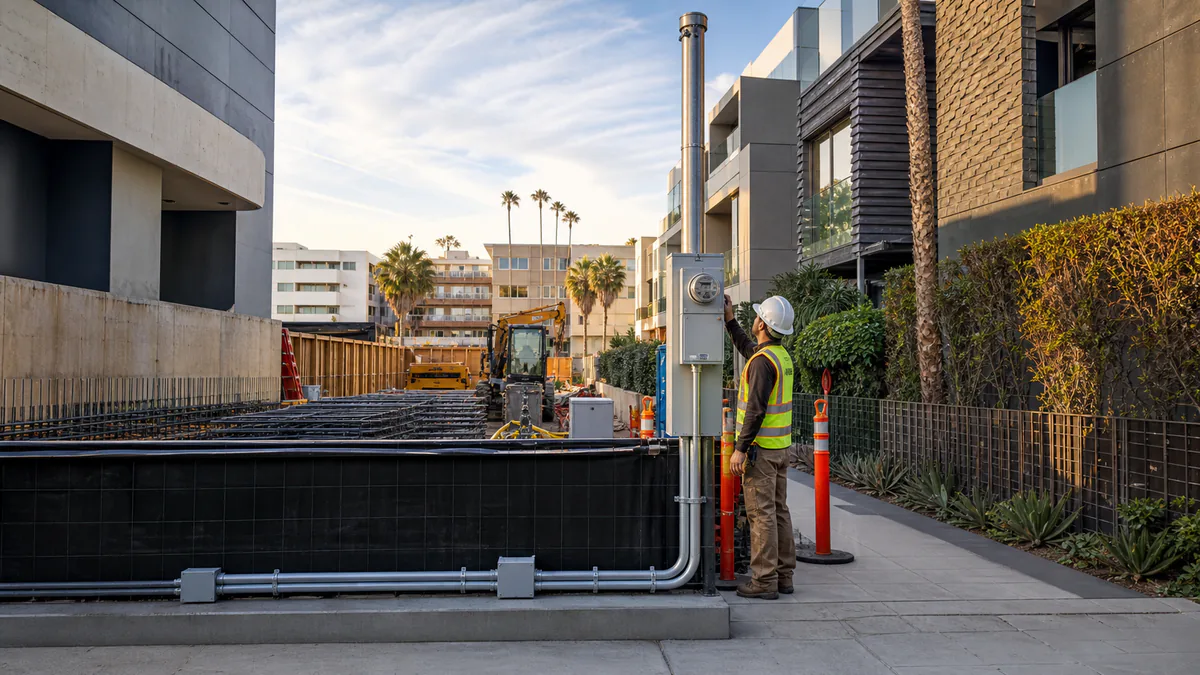
For ACO projects in the IE, that means every installation goes through SCE’s service request and planner process. A service planner is assigned to each project, meets with the general contractor on site to confirm meter placement, and approves the installation before the pole goes in. ACO manages that coordination from start to finish.
Permit Requirements Vary by City
San Bernardino County has a mix of incorporated cities, each with its own Building and Safety department, and unincorporated areas handled by the county. A temporary power installation in Rancho Cucamonga goes through the City of Rancho Cucamonga’s Building and Safety. A project in Fontana goes through Fontana’s department. Ontario has its own process.
The requirements are not the same across those cities. ACO’s permit expeditors know the specific documentation, fee structures, and inspection requirements for each jurisdiction in the Inland Empire. Contractors who assume the process is the same as their last project in a different city sometimes find out otherwise at the permit counter.
One consistent requirement across the IE: an active building permit from the city needs to be on file before the city inspector will release the temporary power pole to SCE. This is the same rule that applies across Southern California and the one that causes the most delays when contractors do not have it in place before starting the temporary power application.
Large Site Projects and Multi-Set Installations
The scale of construction in the Inland Empire is larger on average than in denser urban areas. Warehouse footprints of 200,000 square feet and above are common along the logistics corridors. Residential tract developments span multiple blocks. These project types frequently require multi-set temporary power installations.
A multi-set is required when the utility source is more than 100 feet from where power is needed on site. SCE will not span overhead wire beyond that distance. For large warehouse sites or residential tracts where construction trailers and sub-panels need to be distributed across a site several hundred feet deep, ACO installs a meter pole near the SCE source and additional poles at 80-foot intervals to deliver power where it is needed. Each additional pole in the run can carry a sub-panel for a section of the site or a specific home under construction. More on how this works is on ACO’s overhead and underground systems page.
For multi-set jobs, ACO recommends a job walk before installation. Meeting with the project superintendent on site allows ACO to design a layout that delivers power efficiently across the site rather than discovering mid-installation that the planned pole locations do not work.
Underground Infrastructure in Newer IE Developments
Newer planned communities in Rancho Cucamonga and parts of Ontario have underground utility infrastructure rather than overhead lines. That changes the installation approach. ACO installs the conduit and pole, but on sites where SCE has not yet set the transformer, the connection cannot be completed until SCE’s equipment is in place. This is a sequencing issue that adds time and cost if not identified early.
The fix is straightforward: confirm the status of the SCE transformer before scheduling the pole installation. If the transformer is not yet in place, wait until it is confirmed set before calling ACO out. Installing the pole before SCE is ready means paying for a second trip when the connection is eventually completed.
Construction Trailers on IE Job Sites
Large job sites in the Inland Empire commonly have construction office trailers that need power throughout the project. ACO’s trailer connection service runs the connection from the temporary power pole directly to the trailer panel, covering HVAC, lighting, and office equipment. For multi-set installations where the trailer is at the far end of a run, this connection is built into the last pole in the set.
Serving the Inland Empire Since 1989
ACO has been installing temporary power across the Inland Empire for over 35 years, covering Rancho Cucamonga, Ontario, Fontana, Chino, Montclair, and Upland. If you have a project in the IE and want to know what the setup looks like for your specific site, call (818) 255-3560 or request a free estimate online.