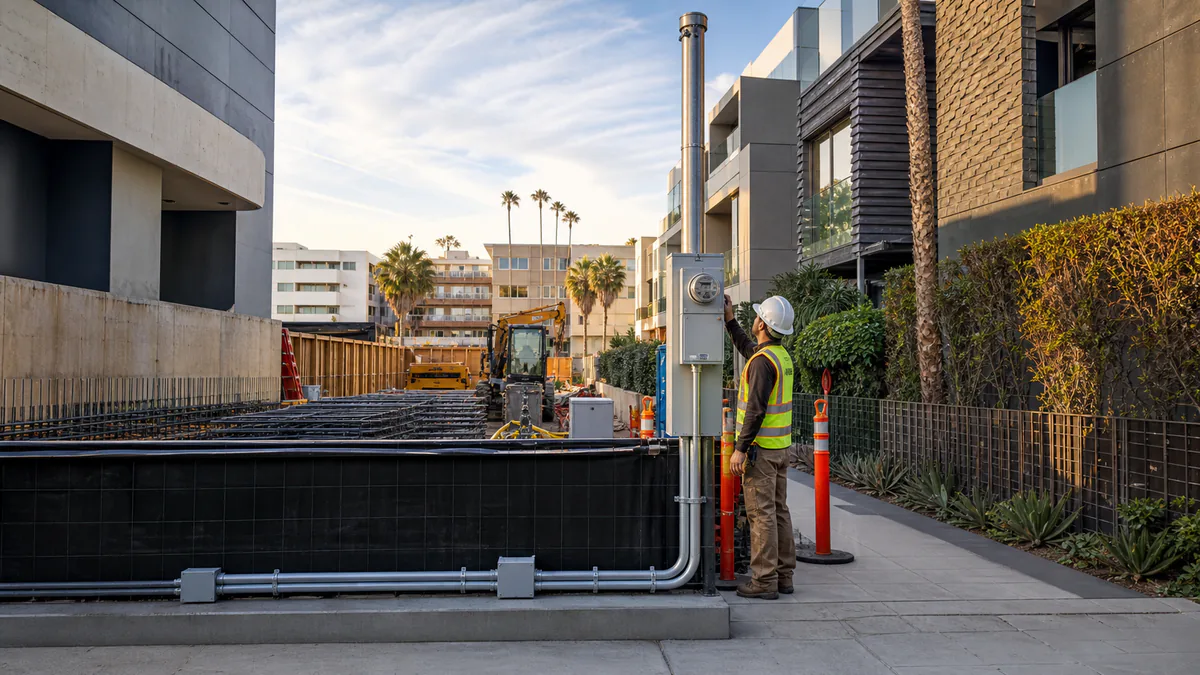

Temporary Power Poles for New Home Construction in the San Fernando Valley
The San Fernando Valley has one of the highest volumes of residential construction activity in Los Angeles. Single-family teardowns and rebuilds, new construction on subdivided lots, ADU additions, and multi-unit residential projects are active across Van Nuys, Reseda, Woodland Hills, Canoga Park, Chatsworth, and the surrounding communities. All of it sits in LADWP territory, which means the temporary power process follows LADWP’s permit and application requirements from start to finish.
If you are a contractor or homeowner managing a construction project in the Valley and need to understand how temporary power poles work in this specific area, here is what you need to know.
The San Fernando Valley Is LADWP Territory
Every city within the San Fernando Valley that falls inside the City of Los Angeles boundaries is served by the Los Angeles Department of Water and Power. That includes North Hollywood, Van Nuys, Reseda, Canoga Park, Woodland Hills, Chatsworth, Granada Hills, Northridge, and Panorama City, among others. For a deeper overview of how LADWP operates and what it covers, see our Los Angeles Power Company overview.
A few cities in the Valley area operate independently from LADWP. Burbank Water and Power serves the City of Burbank. Glendale Water and Power serves the City of Glendale. If your project is in either of those cities, the utility application process runs through their respective departments rather than LADWP, which affects both the timeline and the specific requirements. ACO confirms the correct utility for every project before any application is submitted.
How the LADWP Permit Process Works for Valley Projects
The temporary power permit process in LADWP territory requires two parallel applications: a City Building and Safety Temporary Power electrical permit through the Los Angeles Department of Building and Safety (LADBS), and a separate utility application through LADWP. ACO handles both through its permit pulling service.
Unlike SCE, which requires a service planner to visit the site and approve the meter location before installation, LADWP only requires meter spots on underground sources. For standard overhead installations in Valley neighborhoods with existing overhead utility lines, the process moves more directly from permit approval to installation and inspection.
The condition that stalls Valley projects most often is a missing building permit. LADBS requires an active building permit on file before city inspectors will release the temporary power pole to LADWP. Residential rebuilds and new construction projects in the Valley that start the temporary power process before pulling their main building permit will hit this wall at the inspection stage. Start both applications in parallel, not sequentially.
Overhead Installations on Valley Job Sites
Most residential neighborhoods in the San Fernando Valley have overhead utility lines running along streets and alleys. For the majority of single-family construction projects in the Valley, an overhead temporary power installation is the right approach: faster, less expensive, and straightforward to inspect.
A standard rental pole is a 6x6x24-foot treated wood pole positioned near the LADWP source. For projects on large or deep lots where the construction activity is more than 100 feet from the utility connection, a multi-set installation distributes power across the site with additional poles at 80-foot intervals. ACO’s overhead and underground systems page covers the full range of installation types, including multi-set and black diamond pole options for sites that need additional clearance.
Underground Installations in Newer Valley Developments
Newer planned communities and some rebuilt residential streets in the Valley have underground utility infrastructure. For those sites, the connection runs through buried conduit rather than overhead wire. The installation is more involved and costs more than a standard overhead setup, but it is the required approach when overhead lines are not available at the property.
The overhead vs. underground decision and what drives it is covered in detail in our blog on underground vs. overhead temporary power systems. ACO installs both types across the Valley and will confirm the right approach based on the utility infrastructure at the specific address.
Generator Rentals for Short Valley Jobs
Not every project in the Valley warrants a temporary power pole. Short demolition jobs, quick concrete pours, or site prep work that wraps in a few days may be better served by a generator rental rather than going through the full permit and installation process. ACO offers generator rentals for situations where the job timeline is too short to justify a pole, or where a generator is needed as a supplemental power source alongside existing temporary service.
For longer projects where both options are genuinely in play, our comparison of temporary power poles vs. generators walks through where each option makes sense on Southern California job sites.
Site Lighting for Valley Construction Projects
Residential construction in the San Fernando Valley runs in neighborhoods where site security matters overnight. ACO installs automatic dusk-to-dawn lighting systems that run directly off the temporary power pole without any manual operation. For projects in dense neighborhoods or on sites adjacent to occupied homes, keeping the construction site lit overnight reduces theft risk and addresses neighbor concerns about an unsecured build.
Trailer Connections on Valley Projects
General contractors managing larger Valley projects from a job site office trailer can connect directly to the temporary power pole through ACO’s trailer connection service. That covers HVAC, lighting, and office equipment inside the trailer for the full duration of the project without a separate power source.
Start the Process Early
The full temporary power process in LADWP territory, from permit application to energized pole, typically takes two to four weeks depending on the project and LADWP’s current workload. Starting the application as soon as the building permit is in place keeps the crew from waiting on power after mobilizing. For a full breakdown of what the process looks like from start to finish, see our guide on what to expect when you rent a temporary power pole in Los Angeles.
ACO has been serving the San Fernando Valley since 1989. Call (818) 255-3560 or request a free estimate online to get started.