
Underground vs. Overhead Temporary Power Systems: What’s the Difference?
When contractors in Southern California request a temporary power pole, one of the first questions A-CO asks is whether the utility infrastructure at the site is overhead or underground. The answer determines the installation method, the cost, the timeline, and in some cases whether a particular approach is even possible.
Most contractors on their first job working with a temporary power company assume there is one standard setup. There is not. Overhead and underground systems are fundamentally different installations, and choosing the right one is not always a matter of preference. A lot depends on what the utility has in the ground or on the poles at your site.
Here is how each system works, where each one is used, and what factors drive the decision.
How an Overhead Temporary Power System Works
An overhead system connects to existing utility lines on poles in the street. A-CO installs a temporary power pole on the job site, and the utility company spans a wire from their existing overhead line to the meter on that pole. From there, the site has power.
The temporary pole itself is typically a 6x6x24-foot treated wood pole. In situations where more clearance is needed, a black diamond pole is used instead. These are round poles, 8 to 10 inches in diameter, available in 25, 30, and 35-foot heights. They require full truck access and handle jobs where standard poles do not have the height to clear structures or overhead obstructions.
One constraint with overhead systems is the utility span. SCE and LADWP will not run overhead wire more than 100 feet from their source to the meter pole. When the job site requires power further than that from the utility connection, a multi-set installation is used. A-CO installs additional poles at intervals, typically every 80 feet, with a sub-panel on the final pole to distribute power where it is needed. This is common on track home projects where each home under construction needs its own sub-panel, or on sites where the job site trailer is hundreds of feet from the nearest utility line.
Overhead systems are faster to install and less expensive than underground. For most residential construction, commercial tenant improvements, and standard new construction in Los Angeles, overhead is the default. More detail on how A-CO sizes and installs these systems is on the overhead and underground systems page.
How an Underground Temporary Power System Works
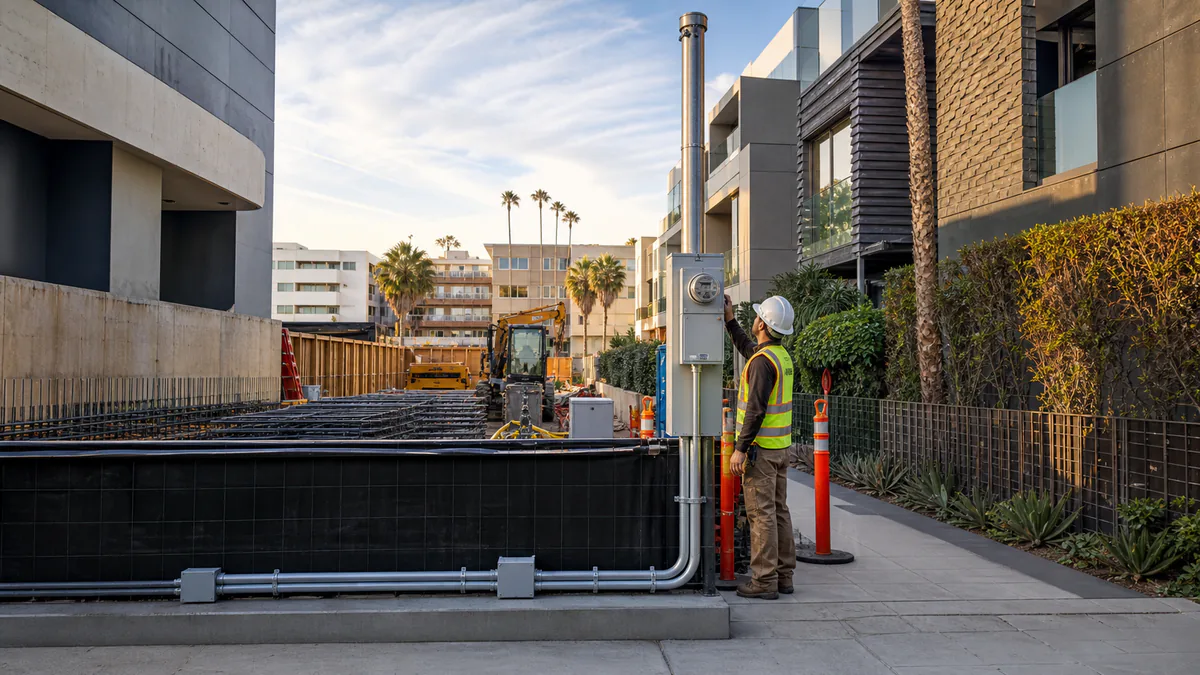
An underground system connects to the utility’s buried infrastructure rather than overhead lines. Instead of spanning a wire through the air, the connection runs through conduit buried in a trench from the utility source to the temporary meter pole on site.
The installation involves trenching, laying conduit, pulling wire through it, backfilling, and then connecting to the utility. It is more labor-intensive than an overhead installation and costs more as a result.
In some cases, the additional complexity goes further. On sites in newer Los Angeles developments where the utility has not yet installed its transformer, A-CO installs the conduit and pole but cannot complete the connection until the utility has their equipment in place. The customer then needs to call A-CO back for a second visit to finish the tie-in once the transformer is set. Coordinating that sequence matters because installing the pole too early means paying for a second trip and a longer wait for power.
For property-line-to-property-line builds where there is no room for tall poles and overhead wire runs, A-CO can also run wire on the ground inside conduit rather than overhead. That approach solves the clearance problem but is more expensive than a standard overhead installation.
What Determines Which System You Need
The single biggest factor is what the utility has at your site. If the street in front of your project has utility poles with overhead lines, an overhead connection is generally the path of least resistance. If the development was built with underground utility infrastructure, that is how the temporary power connection will be made.
In Los Angeles, this breaks down fairly predictably by neighborhood age and type. Older residential neighborhoods and most commercial corridors have overhead lines. Newer planned developments, master-planned communities, and many areas in the Inland Empire, parts of the San Fernando Valley, and newer Orange County and Ventura County developments have underground utility infrastructure.
Beyond utility infrastructure, several site-specific conditions affect the decision:
- Site clearance: If there is not enough vertical clearance for standard overhead installation, either a black diamond pole or an underground run is required.
- Property line constraints: A site building right to the property line on all sides may not have space for overhead pole installation. Running conduit on the ground or underground is the alternative.
- Site congestion: Busy urban sites with heavy foot traffic and equipment movement sometimes benefit from underground runs that keep wire out of the work area.
- Distance from utility source: If overhead infrastructure is too far away and a multi-set is not practical, an underground run may be the better approach.
The Cost Difference
Overhead installations are less expensive. The labor involved is straightforward: install the pole, run the wire overhead, make the meter connection. No trenching, no conduit, no backfill.
Underground installations involve more materials and more labor. Trenching through a job site, particularly one with compacted soil, existing utility lines, or other obstructions, takes time. Conduit has to be sized correctly, installed at the right depth, and inspected before backfill. The wire pull adds another step. On a site where conditions make trenching difficult, costs go up further.
A-CO will give you a clear cost estimate before any work starts. For jobs where the system type is not obvious from site information alone, a job walk helps identify the right approach before any pricing is committed.
The Permit and Utility Process for Each
The permit requirements are the same for both system types. A City Building and Safety Temporary Power permit is required in both cases, along with the appropriate utility application through SCE or LADWP.
Where the processes differ is in the utility’s involvement on site. For SCE overhead installations, a service planner is assigned to the project and meets with the general contractor on site to agree on pole placement before installation. For underground connections, the process involves the utility confirming the tap location and, in some cases, scheduling their own crew to install infrastructure like a transformer pad before A-CO can complete the tie-in.
LADWP only requires a meter spot for underground sources, which simplifies the overhead process somewhat on LADWP-served sites.
A-CO manages all utility coordination as part of the installation process. Contractors are not chasing the utility for updates.
Quick Comparison
| Overhead | Underground |
| Lower installation cost | Higher installation cost (trenching, conduit, backfill) |
| Faster to install | Longer lead time |
| Easier to inspect and service | Harder to access if a fault occurs |
| Works when utility lines are accessible overhead | Required when overhead lines are not available |
| Standard on most residential and commercial builds | Standard in newer LA developments with underground utility infrastructure |
| Needs adequate vertical clearance | No clearance concerns above ground |
| Wire run limited to 100 ft from utility source (multi-set required beyond that) | Wire run via conduit buried in trench |
| Better suited for open job sites | Better suited for congested urban sites or property-line-to-property-line builds |
Which One Does A-CO Recommend?
A-CO does not have a default preference. The right system is whatever matches the utility infrastructure at your site and the physical constraints of the job. On most LA-area construction projects, overhead is faster and more cost-effective, and that is what the site requires. On sites in newer developments or with specific clearance or layout challenges, underground is the necessary choice.
A-CO’s team has been installing both types since 1989 across Los Angeles, Orange, Riverside, and Ventura counties. If you have a project coming up and are not sure which setup applies to your site, call us at (818) 255-3560 or request a free estimate. We will look at the site, tell you what is needed, and handle everything from there.