Temporary Power and Generator Rentals for Construction in Long Beach and the South Bay
Construction activity across Long Beach, Torrance, Carson, Hawthorne, and the broader South Bay runs in a market with a different character than the residential rebuild projects that dominate the San Fernando Valley or the commercial corridors on the Westside. You have a mix of industrial and warehouse construction along the 405 and 710 corridors, multi-family residential development, single-family rebuilds in beach-adjacent neighborhoods, and commercial tenant improvements spread across multiple distinct cities, each with its own Building and Safety department.
All of it is SCE territory. Here is how temporary power and generator rentals work for construction projects in Long Beach and the South Bay.
SCE Serves the Entire South Bay and Long Beach Area
Southern California Edison covers all of the South Bay cities, including Long Beach, Torrance, Carson, Hawthorne, Gardena, Lawndale, Redondo Beach, Manhattan Beach, El Segundo, and Compton. Long Beach operates its own gas utility but is served by SCE for electricity.
The SCE permit process requires a service request to be called in to generate the job at the local SCE planning office. A service planner is then assigned to the project, visits the site to confirm the meter location, and approves the placement before ACO installs the pole. ACO manages that coordination as part of its permit pulling service, along with the Building and Safety electrical permit for whichever city the project is in.
City-by-City Permit Variation in the South Bay
The South Bay spans multiple independent cities, each with its own permitting authority. A temporary power installation in Long Beach goes through Long Beach’s Building and Safety department. Torrance, Carson, Hawthorne, and Gardena each run their own processes with their own submittal requirements, fee schedules, and inspection timelines.
This matters for contractors working across multiple South Bay cities. What clears an inspection in Torrance is not necessarily what the inspector in Hawthorne is looking for. ACO’s permit expeditors have direct experience with Building and Safety departments across all of these cities and submit complete applications that meet each city’s specific requirements.
For a full breakdown of how the permit process works and what ACO handles on the contractor’s behalf, see how ACO handles the permit process so you don’t have to.
Industrial and Warehouse Construction Along the Corridors
The I-405 and I-710 corridors through the South Bay and Long Beach area carry significant industrial and logistics construction. Warehouse buildouts, distribution center upgrades, and light industrial tenant improvements in this zone often have power requirements that differ from standard residential construction.
For larger industrial sites where the utility source is more than 100 feet from where power is needed, ACO installs multi-set temporary power systems with sub-panels distributed across the site. For shell-to-finish warehouse builds where permanent electrical service is not yet connected, a temporary power pole from the start of construction is the standard approach. ACO’s project design service can review the site plans and determine the right system configuration before any equipment is ordered.
When a Generator Makes More Sense Than a Pole
Not every South Bay project warrants a full temporary power pole installation. For short demolition jobs, quick site prep work, or projects where the timeline is measured in days rather than weeks, a generator avoids the permit and installation process entirely.
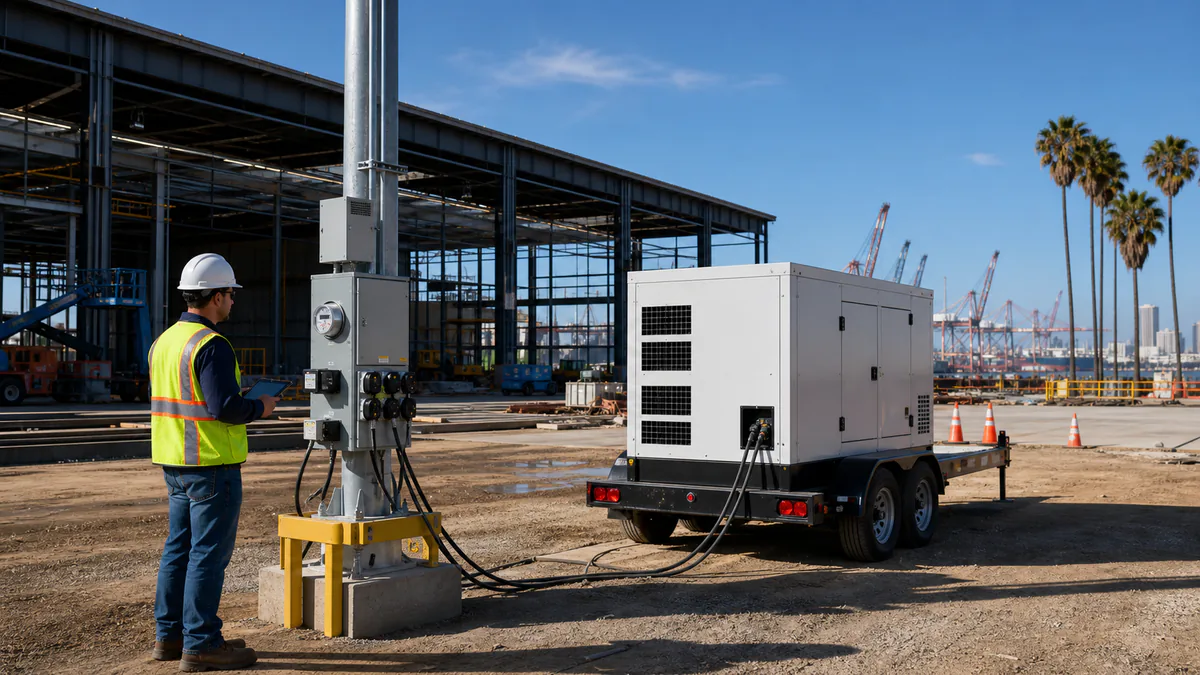
ACO offers generator rentals for projects in the South Bay and Long Beach where a pole is not the right fit. Generators are also useful as supplemental power sources alongside a temporary power pole when a specific piece of equipment has a load requirement that exceeds the installed service capacity.
The decision between a temporary power pole and a generator comes down to job length, site conditions, and load requirements. Our comparison of temporary power poles vs. generators covers the key factors in detail.
Multi-Family and Residential Construction in South Bay Neighborhoods
South Bay neighborhoods, particularly in Torrance, Redondo Beach, and Manhattan Beach, have an active single-family and multi-family residential construction market. Teardown and rebuild projects, lot splits, and small multi-unit builds all require temporary power through the full project duration.
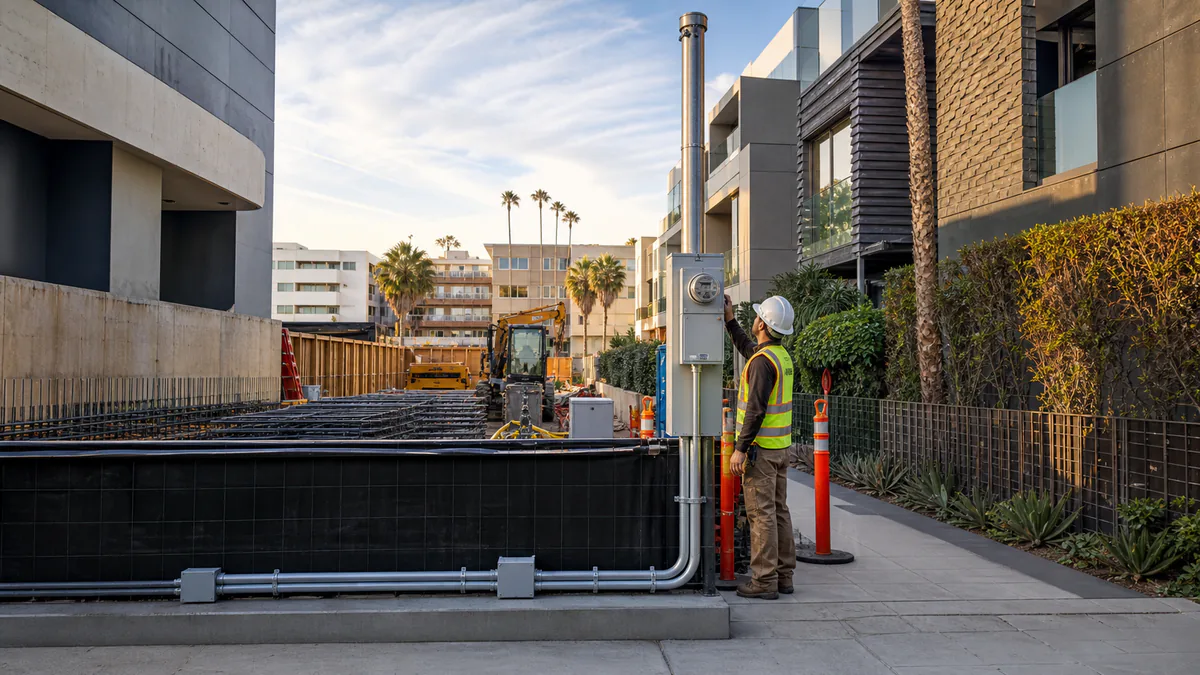
For residential projects in beach-adjacent neighborhoods where overhead utility lines may not be accessible or where clearance is a constraint, ACO may recommend an underground connection or a ground-run conduit installation instead of a standard overhead pole. The underground vs. overhead comparison explains how site conditions determine which system is right.
Lighting and Trailer Connections on South Bay Sites
For construction projects in residential South Bay neighborhoods, automatic dusk-to-dawn site lighting connected to the temporary power pole keeps the site secure overnight without manual operation. For projects with a job site office trailer, ACO’s trailer connection service runs the power directly from the pole to the trailer panel.
Serving Long Beach and the South Bay
ACO covers Long Beach, Torrance, Carson, Hawthorne, Gardena, Redondo Beach, Manhattan Beach, and surrounding South Bay cities. For a full walkthrough of how the process works from first call to energized pole, see our guide on what to expect when you rent a temporary power pole in Los Angeles.
Call (818) 255-3560 or request a free estimate online to discuss your project.