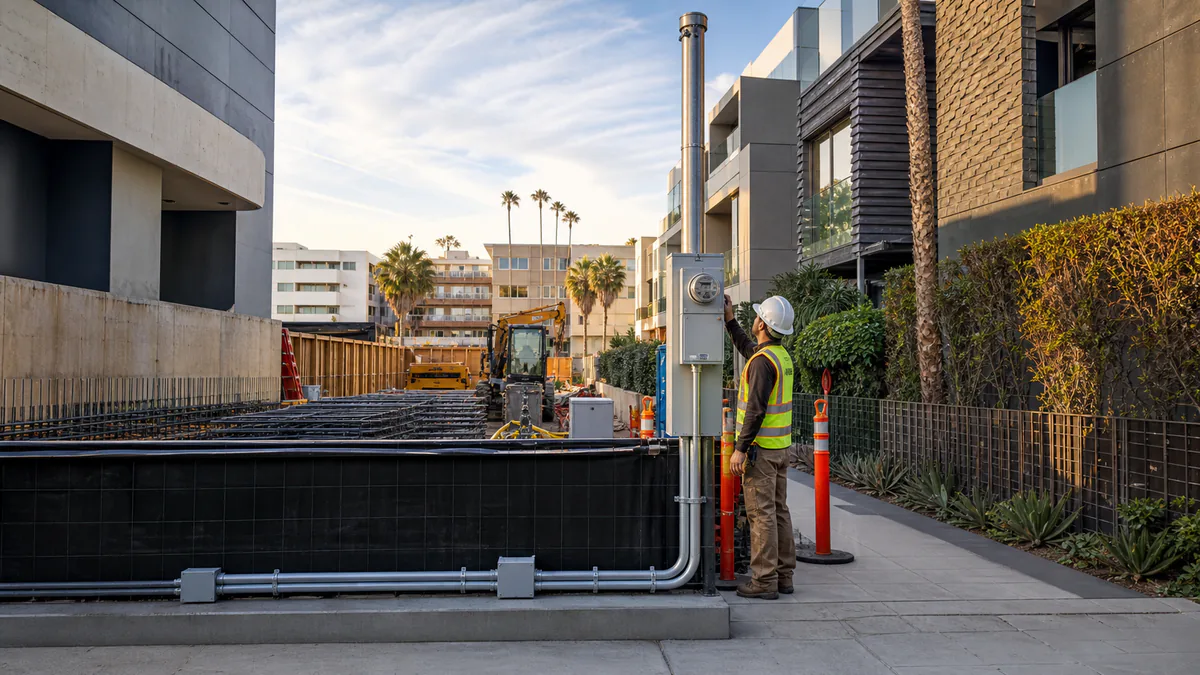

Temporary Power for ADU Construction in Los Angeles: Permits, Timelines, and What to Expect
The ADU boom in Los Angeles has not slowed down. Homeowners across the city are converting garages, adding detached units, and building junior ADUs to meet housing demand and generate rental income. What a lot of those projects run into early is the temporary power question: how do you get power to the construction site, and does an ADU build even require a temporary power pole?
The short answer is yes, in most cases. Here is what contractors and homeowners need to know about temporary power for ADU construction in Los Angeles.
Do ADU Projects Need a Temporary Power Pole?
Not every ADU project requires a standalone temporary power pole. It depends on the size and scope of the build, how far the construction activity is from the existing electrical panel, and whether the work being done draws more load than the existing service can safely support.
For a simple garage conversion where the existing panel is close and the contractor is doing relatively light electrical work, the homeowner’s existing service may be sufficient. For a detached ADU being built from scratch on the rear of the lot, a temporary power pole is typically the right call. The construction crew needs a reliable power source for tools, lighting, and site equipment throughout the build without running extension cords off the home’s main panel.
ACO handles temporary power pole rentals for ADU projects across Los Angeles. If you are not sure whether your project needs one, a quick call to our team is the fastest way to find out.
LADWP vs. SCE: Which Utility Serves Your ADU Site?
This is the first thing that determines the permit process. The City of Los Angeles is served by LADWP. If the ADU is being built within city limits, that is your utility provider. If the address is in an unincorporated area of LA County or in a separate municipality like Burbank, Glendale, or Pasadena, those cities have their own water and power departments with their own processes.
Check the property’s utility bill to confirm who provides service. Getting this wrong at the start of the permit application sends the process to the wrong agency and adds time.
The Permit Process for ADU Temporary Power in LA
The temporary power permit process for an ADU in Los Angeles follows the same path as any other residential construction project. The key documents required are a City Building and Safety Temporary Power permit and the utility application through LADWP. ACO’s permit pulling service handles both.
One requirement that trips up ADU projects specifically: the main building permit for the ADU needs to be active and on file before the city inspector will release the temporary power pole to the utility. LADBS has accelerated ADU permit review timelines in recent years, with most applications now reviewed within 60 days. Still, that window means you want to start the temporary power application as soon as the building permit is issued, not after framing begins.
For detached ADUs being built in the rear of lots with power lines along the back of the property, there may also be utility easement considerations. LADWP needs access to those lines, and construction within the easement zone requires coordination with the utility before work begins.
Overhead vs. Underground for ADU Sites
Older LA neighborhoods with existing overhead utility lines along the street typically use overhead temporary power connections. Newer developments or properties in areas where utility lines are buried require underground connections. ACO installs both overhead and underground systems and will recommend the right approach based on what the utility has at the specific address.
For ADU projects where the build is at the rear of a deep lot and the utility connection is at the front, the wire run may exceed 100 feet. That requires a multi-set installation: a meter pole near the utility source with additional poles installed at intervals to reach the rear of the property. ACO handles multi-set installations regularly on LA residential projects.
Property Line to Property Line Builds
Some ADU projects, particularly in denser neighborhoods, have tight lot constraints. When there is no room for a standard pole and overhead wire run, ACO can run wire on the ground inside conduit instead. This keeps the site clear and eliminates overhead clearance issues. The cost is higher than a standard overhead installation, but it is a workable solution where site conditions require it.
Site Lighting for ADU Construction
For ADU projects that run for several months, ACO can install automatic dusk-to-dawn lighting systems that run off the temporary power pole. This keeps the site secure overnight without any manual operation. In residential neighborhoods, it also helps avoid complaints from neighbors about an unsecured site.
Timeline Contractors and Homeowners Should Plan Around
From the first call to an energized pole, the typical process in Los Angeles takes two to three weeks, assuming the ADU building permit is already in place. The utility’s energization timeline is the variable that is hardest to predict. Starting the temporary power application as early as the project allows keeps construction from sitting idle waiting on power.
ACO serves ADU projects across the City of Los Angeles and throughout LA County. Call us at (818) 255-3560 or request a free estimate online to get started.